Building Ayn from Scratch
August 2024
Leading design on Ayn, Dal’s all-in-one KYC and compliance platform — turning one of the most complex regulatory workflows into something an operations team could run confidently, without a specialist for every edge case.
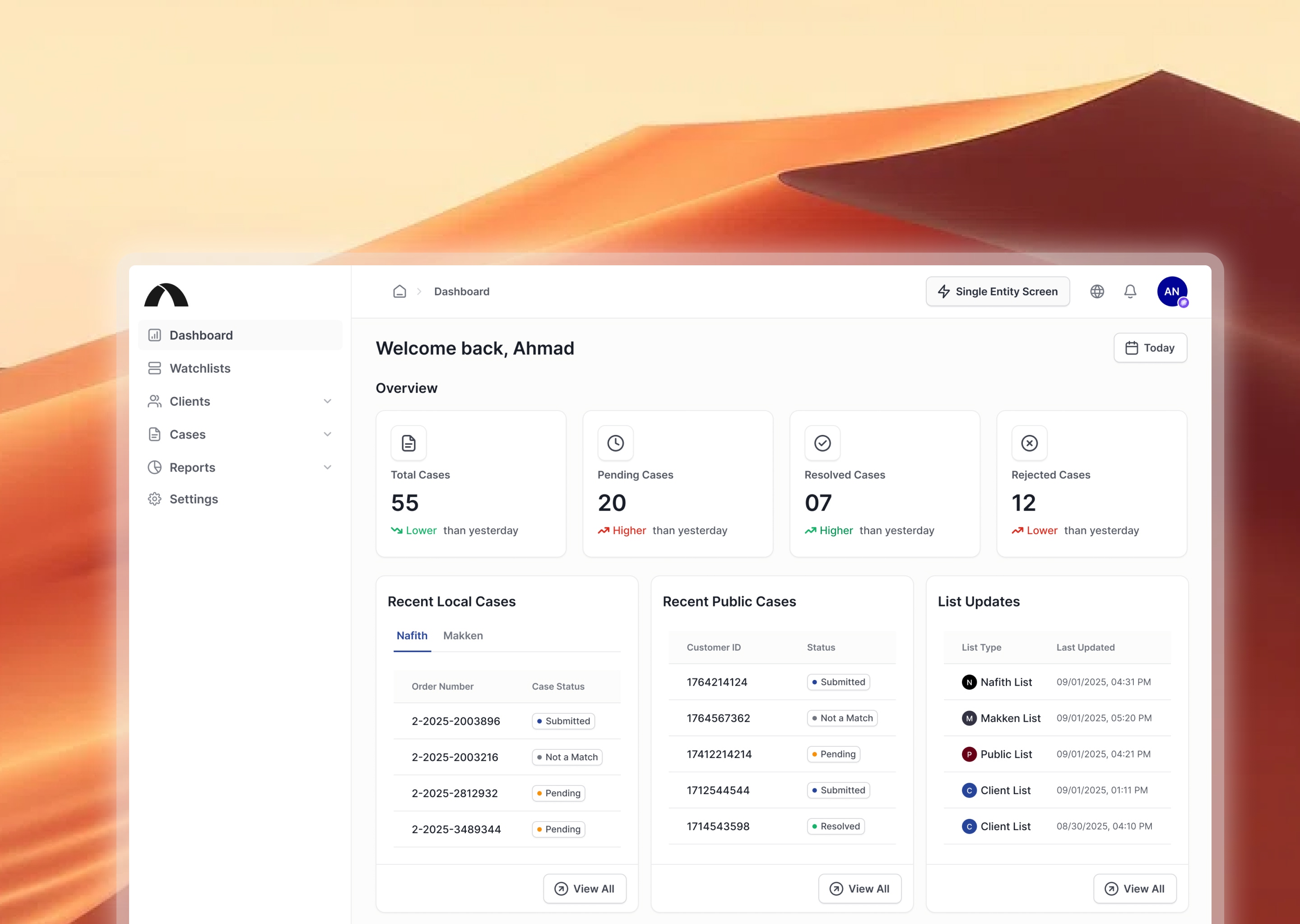
Where the work happened — four months, Figma and four ops teams’ real queues.
The problem
When Dal set out to build Ayn, KYC and compliance operations at most companies ran across a patchwork of tools: a document upload portal here, a manual spreadsheet there, a third-party identity verification API nobody fully understood, and a compliance officer whose entire job was stitching it all together and hoping nothing slipped through.
Internal research showed compliance teams spent 61% of their time moving between tools — not doing compliance work. That one number was Dal’s whole bet: unify the workflow into one purpose-built surface — document collection, identity verification, risk scoring, audit trail, case management — and compliance becomes something a trained ops person can do confidently, not something that needs a specialist for every edge case.
Living inside the feature
Before any wireframes, I spent two weeks shadowing four ops teams — companies ranging from a 40-person fintech to a 300-person payments business — watching compliance officers run real KYC checks, re-verification flows, and audit prep. 23 pages of notes became a friction map covering every step from “new applicant arrives” to “case closed.”
Working with our compliance specialist, I mapped AML/KYC requirements across three jurisdictions — not to become a compliance expert, but to separate what was legally constrained from what was just legacy process. That distinction drove every prioritization call that followed. Then 16 interviews across three user types — compliance officers, ops leads, CFOs — each with a different definition of “good”: control and auditability, speed and clarity, confidence that nothing was missed.
“I have six tabs open just to check one applicant. And I still can’t tell you if we’re done or not.”
That was a compliance officer, eleven minutes into a twenty-minute session, unable to answer the most basic question about her own case.

Two weeks shadowing four compliance teams — 23 pages of friction before a single wireframe.
What broke trust
KYC was scattered across six or more tools. Document collection lived in one place, identity verification in another, risk scoring in a third, the audit trail in a manual spreadsheet. No one had a complete view of a single case, and compliance officers spent more time moving data between systems than reviewing it.
Case status was invisible to everyone outside compliance. Sales didn’t know why onboarding was taking three weeks. Management didn’t know how many cases were at risk. When auditors asked for a status report, someone built one by hand — every time.
Re-verification restarted every case from zero. An expired ID or a changed risk score meant redoing all the documents and checks as if the case were brand new, with no context for why the re-check was triggered in the first place.
Four bets
A two-day sprint with the PM, engineers, and our compliance specialist mapped every friction point against user impact versus regulatory sensitivity — because some things that looked like good design moves were actually locked in by the regulation itself. Four bets came out of it: a unified case file, status as a first-class citizen, smart incremental re-verification, and risk scores made readable.
The unified case file won the room immediately — everyone could picture six tabs collapsing into one, and it became the foundation the other three bets were built on top of.

Two-day design sprint, one 2×2 of user impact versus regulatory sensitivity — four bets came out of it.
What shipped
Everything about one entity — documents, checks, risk score, communication history, audit log — now lives on a single case file. No tabs, no switching, no guessing what’s still outstanding.
Case status became a first-class citizen — visible to compliance, ops, and management without a single status email.
Re-verification now carries forward everything still valid; only what’s expired or changed triggers a new check, with the full case history visible alongside the active review. Every risk score displays its contributing factors in plain English, with a one-click path to challenge or escalate — the black box became a dialogue.

Before/after: six tools collapsed into one case file. Average completion time dropped from 4.2 hours to 1.3.
What changed
Average KYC check completion time fell 68%, from 4.2 hours to 1.3. Re-verification time fell 74%. Operations team satisfaction hit 91% at launch — the highest score in Dal’s product history at that point — and risk-score challenges logged by officers tripled, because for the first time they could see the logic well enough to argue with it.
“I haven’t sent a Friday status email in three months. I didn’t even notice until someone asked me why I stopped.”
That was the moment I knew the design had worked. Not the metrics — though those were good — but the fact that a process so embedded it had become invisible finally became unnecessary.
Reflections
Regulatory constraints are design constraints in disguise. Every time I wanted to simplify a step, our compliance specialist explained why it existed in the regulation. The rule rarely dictates how information is presented — only that it must be captured. That gap is where design lives.
Enterprise users deserve consumer-grade clarity. Compliance software has hidden behind “it’s complex” as an excuse for bad UX for years. Our users carried more cognitive load and more consequence for error than any consumer app’s — that’s an argument for better design, not worse.
Observation beats interviews for workflow problems. What compliance officers said they needed in interviews and what they actually did when I watched them work were often two different problems. Watching wins, every time.